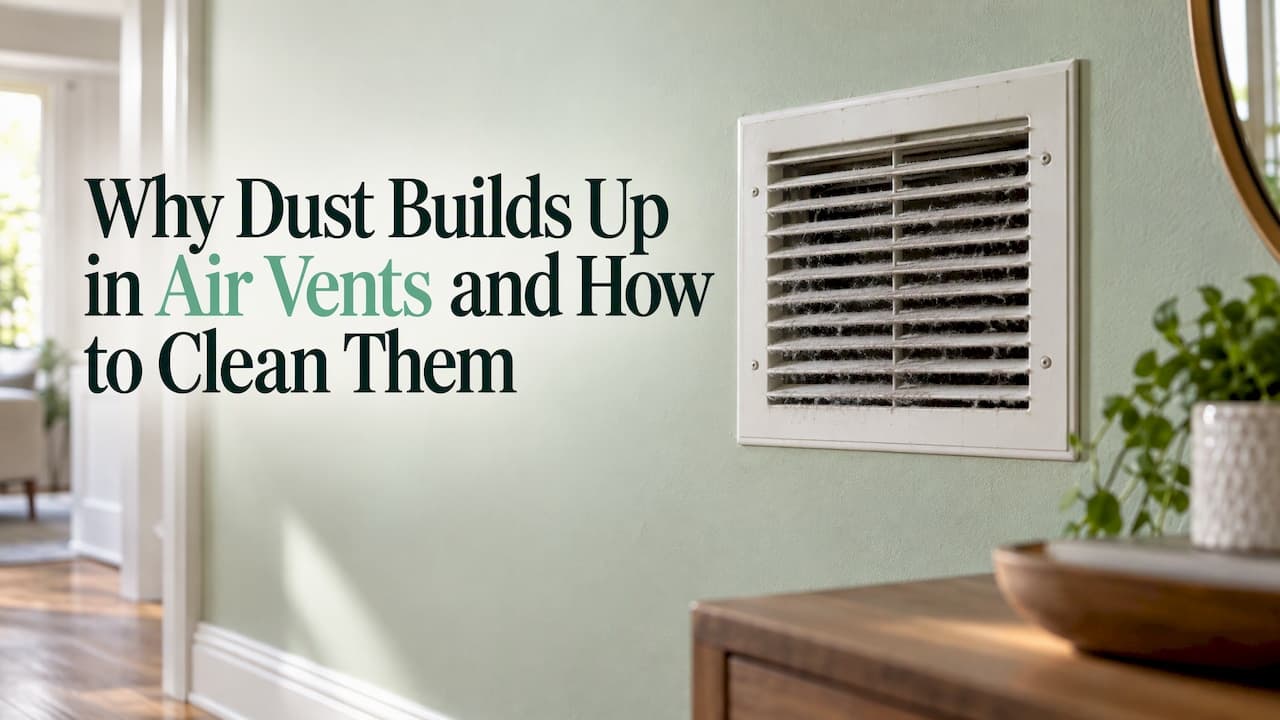
Dust on or around your air vents is normal, and most of the time it can be fixed without touching your ductwork. Turn the system off, take the covers off, wash them, vacuum just inside the opening, and check your furnace filter. Full duct cleaning is only worth paying for in a short list of situations, and we cover them below so you can tell the difference.
We clean homes across Richmond Hill, Markham, Vaughan and Aurora, and vents, baseboards and fixtures are part of what we do on a visit. This guide is what we would tell a neighbour who asked why her vents keep going grey.
TL;DR
- Dust on a vent cover does not automatically mean dirty ducts. Save on Energy says it can mean the furnace filter is missing or not doing its job.
- To clean covers safely: switch the HVAC off, unscrew the covers, wipe or wash them, vacuum the visible opening, let everything dry, and reinstall.
- Check the furnace filter monthly in the heating season and replace it about every three months, or as the manufacturer says.
- Routine duct cleaning is not recommended by Canadian or US official sources. Mould, pests, renovation debris, heavy dust or a musty smell are the reasons to get an inspection.
- Regular home cleaning keeps the dust load down at its source, which is what matters most.
Table of Contents
- Why dust collects on and around your vents
- Is dust in your vents harmful?
- How to clean dusty air vent covers, step by step
- How often to clean vents and change filters
- What about the fine white dust?
- When full duct cleaning is actually warranted
- Our view: keep dust out of the air before it reaches the vents
- Let us handle the dust for you
- Common questions
- Sources
Why dust collects on and around your vents
Ducts do not make dust. According to CMHC's "About Your House" guide, household dust commonly comes from soil tracked in from outside, open windows and other openings, skin and hair, pets, carpet, clothing, bedding and hobbies. The air moving through your vents simply carries some of that dust and drops it where the air slows down or changes direction, which is the grille.
That is why a vent cover in a busy hallway gets furry faster than one in a guest room. Three things speed it up:
- A weak or missing furnace filter. The same CMHC guide says a good filter can reduce the dust circulating in ducts and protect the furnace heat exchanger, coil and supply ducts. It also says a filter will not give you a dust-free home, because many dust sources are outside the HVAC system.
- Pets, carpet and bedding. Fibres and dander are constantly being stirred up and pulled into return vents.
- Open windows, foot traffic and a recent project. Sanding, drywall work and flooring installs put fine particles into the air for weeks.
The practical takeaway: if the grilles look dusty a few weeks after cleaning, start by looking at the filter and at how much dust your home generates, not at the ducts.
Is dust in your vents harmful?
For most households it is a nuisance more than a hazard, but it matters for people with allergies or asthma. Health Canada's Healthy Home guide says dust and dust mites can trigger allergic reactions and pre-existing asthma. It recommends wet-cleaning hard surfaces, vacuuming weekly (preferably with a HEPA vacuum) and having heating and cooling equipment inspected and maintained routinely.
The Canadian Lung Association describes dust as a mix of biological and chemical substances that can make breathing harder for people with allergies and asthma. Its advice is plain: replace furnace filters regularly and vacuum your heating vents.
On the question of dust that sits inside the ducts, the US EPA says light duct dust has not been shown to be a health risk or to raise the particle level in the home, because much of it clings to duct surfaces. That is a US source, but it lines up with what the Canadian sources say. If someone in your household has asthma, talk to your doctor or pharmacist about your triggers rather than guessing at the cause.
How to clean dusty air vent covers, step by step
Cleaning the covers is the part you can do in about 30 minutes for a typical home. The method below follows Martha Stewart's guide to cleaning air vents, which was written with a cleaning expert, along with Canadian asthma guidance on keeping dust from spreading.
What you need
- A screwdriver
- Dish soap and warm water
- Microfiber cloths
- A vacuum with brush and crevice attachments, ideally HEPA-filtered
- A soft-bristled brush
- A towel or tray for drying the covers
The steps
- Turn the HVAC system off. The guide explains that a running system can draw loosened dust and debris into the equipment. Switch the thermostat to off, and wait for the fan to stop.
- Remove the covers. Most unscrew with a screwdriver. Some simply lift out. Keep the screws in a small bowl and note which cover goes in which room if the sizes differ.
- Dry-wipe first. A slightly damp microfiber cloth picks up dust instead of throwing it into the air. Canadian asthma guidance recommends slightly moist cloths and a sealed HEPA vacuum, because feather dusters spread allergens around.
- Wash the covers. Scrub with warm, soapy water and the soft brush, paying attention to the slats. Rinse and let them air-dry fully on a towel.
- Vacuum the opening. With the crevice and brush attachments, remove the visible dust and debris just inside the vent. Stay within reach: this is a surface clean of the opening, not a duct cleaning.
- Reinstall the covers once they are completely dry, and turn the system back on.
- Check the filter while you are at it. If it is grey and clogged, replace it now.
A few cautions
- Do not spray chemical sealants or coatings into the ducts. The asthma guidance above warns that chemical sealants can cause health problems as they break down.
- Use a stable step stool for ceiling-mounted grilles.
- If a cover is stuck, painted over or you find damp, mouldy or crumbling material behind it, stop and see the section on inspections below.
- Wall and floor vents in older homes can hide dropped toys, pet hair or renovation scraps. A flashlight helps you see what is in the first stretch.
How often to clean vents and change filters
There is no single schedule that fits every home, but the official guidance gives a good frame.
| Task | Suggested frequency | Source |
|---|---|---|
| Check furnace filter, clean or replace | Monthly during the heating season | CMHC Home Maintenance Schedule |
| Replace furnace filter | About every three months | Save on Energy |
| Check HRV filters | Every two months | CMHC Home Maintenance Schedule |
| Replace or clean filters | Per manufacturer's instructions; keep heating vents clear | Health Canada |
| Vacuum floors and soft surfaces | Weekly, HEPA if possible | Health Canada |
For the vent covers themselves, no official body sets a number, so go by what you see. A sensible rhythm is a quick wipe or vacuum of the grilles whenever you do your regular cleaning, and a full remove-and-wash a few times a year. Homes with pets, smokers, small children or ongoing renovations will need more.
Filter makers suggest shortening the interval in dusty conditions. Filtrete Canada recommends changing at least every three months, and more often during construction, sanding, pet ownership, smoking or continuous fan operation. The same FAQ notes that a filter captures some dust but cannot eliminate dusting, since larger particles settle before they reach it.
What about the fine white dust?
If the dust you find is a fine, chalky white powder on furniture, rather than grey fluff on the grilles, the vents may not be the cause. One humidifier maker's guide says the white deposit from an ultrasonic humidifier is mineral residue, mainly calcium and magnesium from the water. The same page says evidence on the health effects of inhaled humidifier minerals is limited, and that people with asthma or respiratory sensitivity may be more susceptible.

A quick check: does the powder appear mainly in the room with the humidifier, and does it stop when the humidifier is off? If so, look at the humidifier before the ducts. Wipe the powder up with a damp cloth rather than dry dusting.
When full duct cleaning is actually warranted
This is where most online articles push hard. The Canadian official sources are much more cautious.
- CMHC reports that research found little or no change in airborne particle levels or duct airflow after duct cleaning, and says regular duct cleaning is probably unnecessary for most households. It adds that cleaning may help where serious moisture or blockage problems exist, and advises against broadcast spraying of biocides in ducts.
- Save on Energy says routine duct cleaning as part of heating and cooling maintenance is not needed.
- National Defence's occupant handbook says duct cleaning usually does not change the quality of air you breathe, significantly affect airflow or lower heating costs, and that disturbing the system can temporarily raise airborne particles.
- The US EPA, as supplementary guidance, says routine cleaning is not recommended and should be considered when there is substantial visible mould, vermin in the ducts, or excessive dust and debris coming out of the supply registers.
So your next step depends on what you see.
| What you notice | Reasonable response |
|---|---|
| Dust on vent covers, nothing else | Clean the covers, replace the filter, step up regular home cleaning |
| Dust returns within days of cleaning | Check filter fit and quality, reduce dust sources, vacuum with HEPA |
| Large amounts of dust blowing from registers | Get an inspection |
| Musty smell, visible mould or damp ducts | Find and fix the moisture, then get an inspection |
| Signs of animals or insects in the ducts | Get an inspection |
| New build or major renovation | Consider an inspection for leftover construction debris |
| Reduced airflow or unexplained symptoms | Get an inspection |
The last five rows follow Save on Energy's list of reasons to consider cleaning or inspection: animals or insects, a new home or large renovation, large amounts of dust, unexplained symptoms, reduced airflow, large deposits or a musty odour.
If you do hire someone for the ducts
Save on Energy advises asking any provider to show evidence that cleaning is needed, asking about their experience, avoiding chemical treatments unless you understand their pros and cons, and being wary of sweeping claims that routine cleaning brings health benefits.

Mould needs particular care. The EPA says wet or mouldy insulated ducts generally need the affected insulation removed and replaced rather than cleaned, and the moisture source must be corrected or the mould can return. That is a job for a qualified HVAC contractor, not a household cleaner and not a DIY weekend.
Our view: keep dust out of the air before it reaches the vents
We see the same pattern in homes across Richmond Hill, Markham, Vaughan and Aurora. Families call us about dusty vents, and the vents are rarely the root problem. They are where the dust from the rest of the house ends up.
That is why we do not treat vents as a separate chore. On a visit we clean the covers, baseboards, fixtures, cabinets and appliances together, because dust moves between all of them. A wiped grille above a dusty baseboard will be dusty again in a week.
What makes the difference is consistency. We send the same trusted team each time and build a custom checklist around your home: the pet-hair corner, the bedroom vents, the nursery, the basement that gets the construction dust. Over weeks that routine does more for dust than any one-off effort, and a recurring schedule, weekly or bi-weekly, is how we recommend households with allergies or pets keep ahead of it.
If you are coming out of a renovation, we do post-renovation cleaning built for fine drywall and sanding dust, and a deep clean is a good reset before starting a recurring plan. Our satisfaction guarantee means that if something is missed, we come back to put it right.
vandal
Let us handle the dust for you
If you would rather spend the weekend with your family than on a step stool, we can build vents and the surfaces around them into a custom checklist. We serve Richmond Hill, Markham, Vaughan and Aurora, with same-week availability and a 5-star rating from over 200 clients.

A One-Time Clean starts from $180 and a Move-In / Out Clean from $280. Recurring house cleaning, deep cleaning and post-renovation cleaning are quoted to your home, and you can request a quote on our site or by phone. Ready to get started? Request your quote.
Common questions
Is it okay to never clean air ducts?
For most homes, yes. Save on Energy says routine duct cleaning is not needed as part of normal heating and cooling maintenance, and CMHC calls it probably unnecessary for most households. Keep up with filter changes and surface cleaning, and arrange an inspection if you notice mould, pests, heavy dust from registers or a musty smell.
How do I remove dust from air vents?
Turn the HVAC system off, unscrew the covers, wipe them with a damp microfiber cloth or wash them in warm soapy water, and let them dry. Vacuum the visible opening with brush and crevice attachments, then reinstall the covers. Replace the furnace filter if it is dirty.
Why is there so much dust coming out of my vents?
The ducts are usually carrying household dust, not making it. Check the furnace filter first, since a missing or worn one lets dust through. Large amounts of dust blowing out of the registers, especially after a renovation, is one of the reasons to have the system inspected.
How can I tell if there is mould in my air ducts?
Warning signs include a musty odour, visible mould on grilles or inside the opening, and damp or wet ducts. Do not try to clean it yourself or spray anything into the ducts. Have a qualified HVAC contractor inspect, and fix the moisture source, since mould can return if it remains.
Sources
- Healthy home guide, Health Canada
- Air quality in your home, Canadian Lung Association
- About Your House, CMHC
- Air duct cleaning: what you should know, Save on Energy
- Should You Have the Air Ducts in Your Home Cleaned?, US EPA
- How to Clean Your Air Vents, Martha Stewart
- Guide for Reducing Allergens and Irritants in the Home, Asthma Canada
- Home Maintenance Schedule, CMHC
- Improve indoor air quality in your home, Health Canada
- Occupant Handbook: Indoor air quality, National Defence
- Frequently Asked Questions, Filtrete Canada
- White dust from a humidifier, Air Oasis